






















01
Necessary Always on
Required for the site to work (login, preferences, security). Always on.
NVIDIA's local AI announcements from a business perspective: memory, performance, costs and data flows to check before buying hardware or deploying agents.
Local AI is central to NVIDIA's 3 September 2026 IFA announcement, which describes open-weight models and tools for running them on RTX, DGX Spark and Jetson, including the 30-billion-parameter Nemotron 3.5 Lightning. Updated on 28 October, this analysis separates the manufacturer's stated features from the checks an SME or MSP needs before buying hardware or connecting an agent to business data.
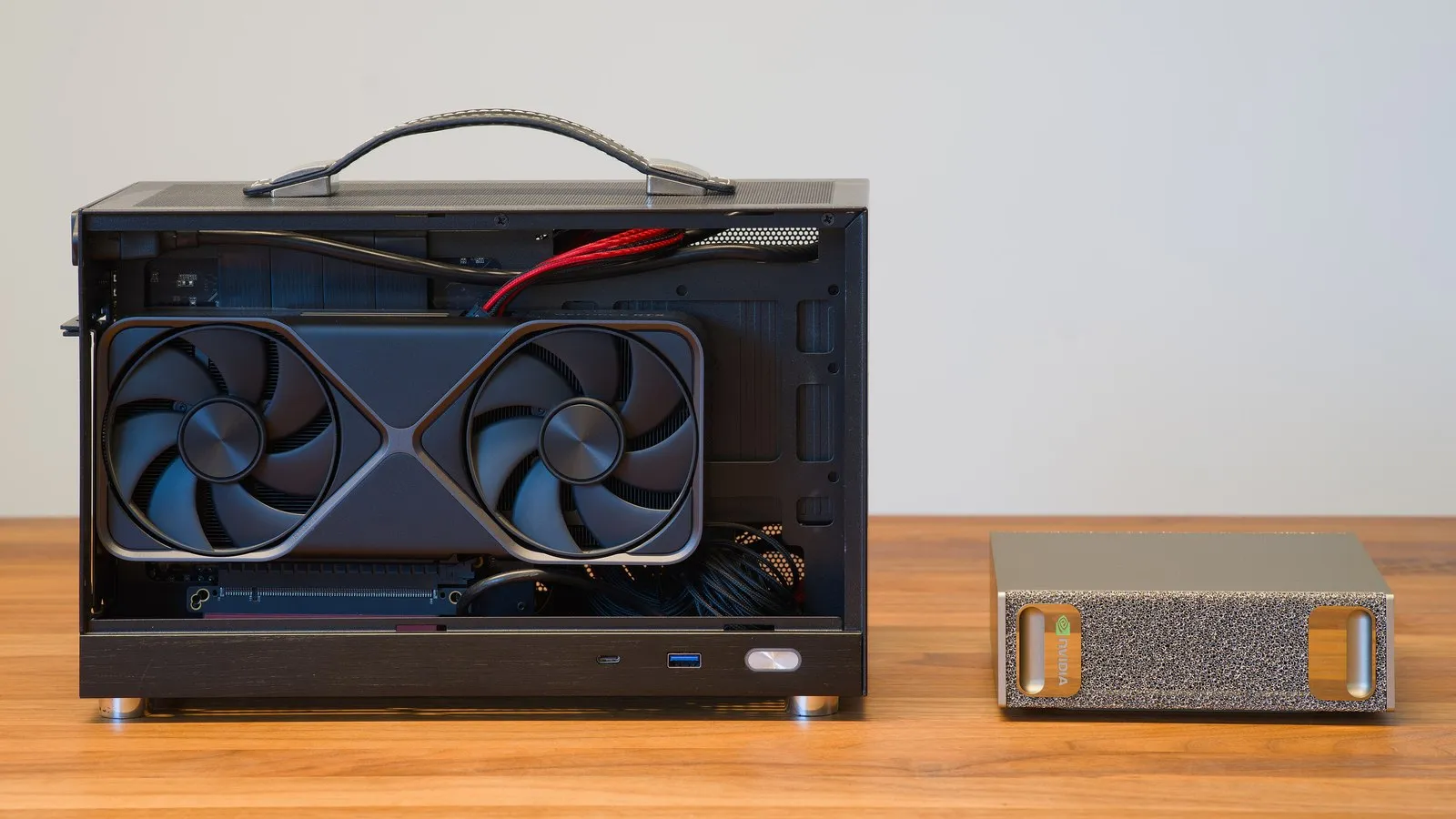
NVIDIA isn't the only source of the models here. Qwen released Qwen3.8-Flash-Next, an open-weight multimodal mixture-of-experts model for DGX Spark and DGX Station, alongside a smaller Qwen3.8-27B tuned for local agentic and coding work. Meta's Muse Glimmer, a 30-billion-parameter open-weight coding and agent model, runs on RTX PCs, DGX Spark, DGX Station and Jetson. DeepSeek's v4 Flash, a 284-billion-parameter mixture-of-experts model with 13 billion active parameters, is sized to run on a two-node DGX Spark cluster, and LTX's LTX 2.5 video-generation model targets RTX GPUs and DGX hardware with new memory-efficiency optimizations.
NVIDIA also pointed to RTX Spark Windows PCs arriving from Lenovo and Acer, built around a 1-petaflop RTX Blackwell GPU with up to 128GB of unified memory — aimed at developers who want workstation-class local inference in a PC form factor. To manage inference across more than one machine, NVIDIA introduced PAIR (Personal AI Router), a tool that distributes AI workloads across networked PCs, working with GeForce RTX 20-series GPUs and newer.
Promises about ease of use and speed remain the manufacturer's claims, not measurements performed by Altovar. The launch windows mentioned refer to the 3 September announcement: commercial availability, operating-system support and compatibility of a particular configuration must be checked directly before purchase. We do not present rumours as facts or infer memory requirements from parameter count alone.
The pitch is lower friction for running models locally: NVIDIA says popular agent apps built on llama.cpp will get simplified one-click local setup on Windows, removing some of the manual work of picking a model, finding a compatible inference server and tuning quantization settings. For organizations with data-residency or latency constraints, that lowers the bar for running capable models on-premises or at the edge instead of depending on a cloud AI provider — though buyers should still validate their own performance and total cost of ownership rather than taking NVIDIA's throughput figures as a guarantee.
Before a trial, choose a bounded task such as finding information in test documents or preparing a code change. Record the model, quantization, available memory, context length and concurrent request count. Measure time to the first useful response and time to completed work, including errors and review. A demo with one request does not show that a machine can support an entire office. When comparing with APIs, include purchase price, electricity, maintenance, updates and management hours: the absence of a per-token bill does not make the service free. Keep the same workload and acceptance criteria throughout the comparison.
Check data flows separately. Running a model on a PC does not guarantee that connectors, telemetry, web searches or requests routed to a remote model stay on that device. Try the workflow with synthetic data, restrict tool permissions and check what happens if the network or a participating machine is unavailable. An MSP should also separate customer archives and credentials. Adoption should begin with a verifiable result and clear operational responsibility; Altovar's artificial intelligence services provide a starting point for defining the scope, the person responsible for review and the criteria used to judge whether deployment is worthwhile.
Sources: NVIDIA Blog.