





















01
Necessary Always on
Required for the site to work (login, preferences, security). Always on.
Atlassian's CVE-2026-21589 (CVSS 9.3) lets an unauthenticated attacker read specific files in the web root of self-hosted Data Center products. Cloud is patched. Proof-of-concept code and exploitation attempts followed within a day of disclosure. Fixed versions and an MSP triage order.
On 5 October 2026 Atlassian emailed Data Center customers an "Action required" notice for CVE-2026-21589, a critical arbitrary file-access vulnerability rated CVSS 9.3. In Atlassian's words on CONFSERVER-104488, it "allows an unauthenticated attacker to access specific files within the web application root directory." Exploitation requires prior knowledge of a file's exact name and path, and the flaw does not allow directory listing. Affected Atlassian Cloud products are already patched and no Cloud customer action is required.
The picture changed after disclosure. On 6 October watchTowr Labs published a technical analysis with proof-of-concept code, and SecurityWeek reports that the exploitation-intelligence firm Previdian recorded exploitation attempts from that same day: 190 attempts from 32 IP addresses in 10 countries by 8 October. Rapid7 recommends patching on an emergency basis, outside normal patch cycles. As of 9 October 2026, CISA has not added the CVE to its Known Exploited Vulnerabilities (KEV) catalog.
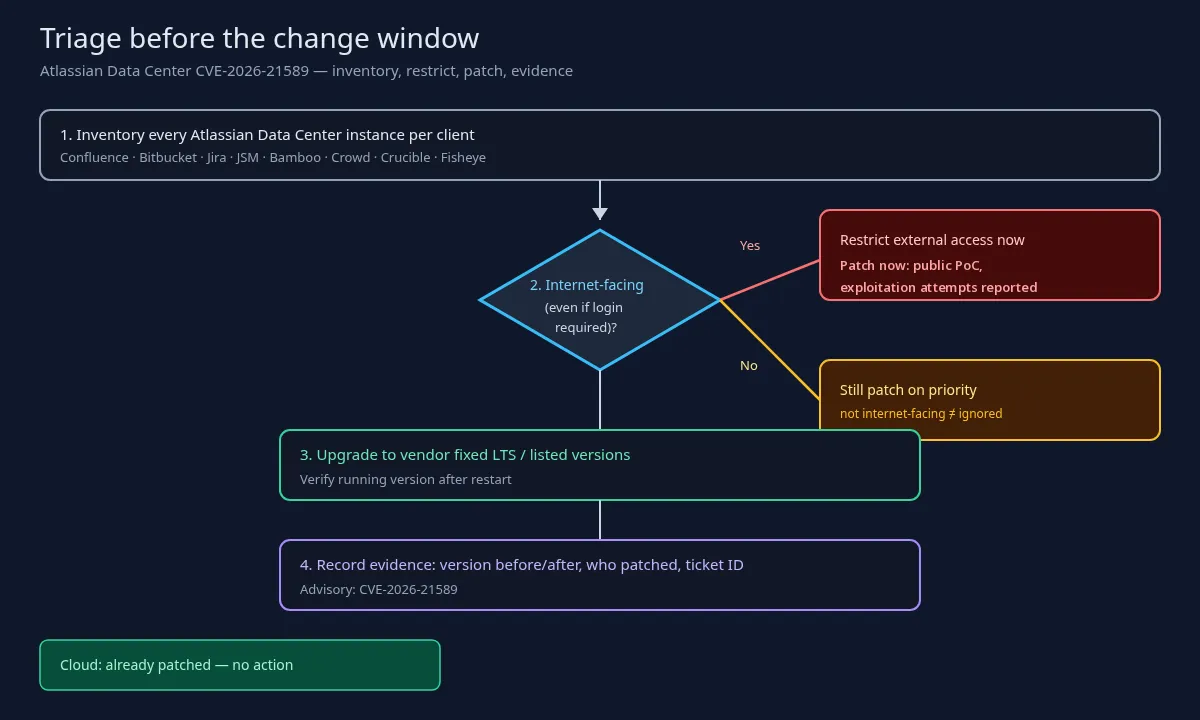
Self-hosted Data Center across Confluence, Bitbucket, Jira Software, Jira Service Management, Bamboo, Crowd, Crucible and Fisheye needs attention now. For MSPs, internet-facing plus unauthenticated is the triage filter, and the work runs in order: inventory, restrict external access, patch to the vendor's fixed versions, then review logs.
This article covers the fixed versions, what "arbitrary file access" means in Atlassian's own terms, the interim restrict-from-internet posture and how to keep this advisory apart from neighbouring stories. It contains no attack steps and no file paths.
Atlassian's own summary is the reference. On the Confluence advisory ticket, the company says exploitation "requires prior knowledge of the target file's exact name and path" and that the issue "does not allow attackers to enumerate or list directory contents." Those two limits frame the realistic risk.
They are narrower than they sound. Atlassian also warns: "In some configurations, there may be sensitive files present that increase your risk." Public research since disclosure shows why. According to SecurityWeek, in deployments where Jira is integrated with Crowd, watchTowr was able to read a configuration file that stores Crowd application credentials in plaintext and use them to obtain Jira administrator rights. Treat unexpected backups, exports or configuration copies in the web root as hygiene debt to clean up after patching. This article names no paths.
Cloud versus Data Center is a clean split. Affected Atlassian Cloud products have been patched, Atlassian says its investigation found no evidence of exploitation, and no Cloud customer action is required. All Data Center versions before the fixed releases are affected, and versions past end of life may be too; Atlassian recommends upgrading to a fixed LTS version or later. Atlassian rates the issue Critical, CVSS 9.3.
For client communication: customers received an "Action required" email, the Atlassian advisory tickets carry Highest priority, and the Confluence ticket classifies the issue as path traversal (arbitrary read/write). NVD lists the weakness as CWE-552, files or directories accessible to external parties. What a client needs to hear is simpler: unauthenticated access to specific files when the exact path is known, no directory listing, Cloud already handled, exploit code public, and Data Center must move to a fixed version now.
On exploitation status: Atlassian's advisory reported no evidence of exploitation at disclosure. Since then, exploitation attempts have been reported, as above. The CVE is not in CISA's KEV catalog as of 9 October 2026, but absence from KEV is no reason to wait. Treat any internet-facing Data Center instance that is still unpatched as exposed.
Fixed versions, as listed on Atlassian's advisory tickets and in the CVE record, and matching Rapid7's CVE-2026-21589 page:
Each product has its own Atlassian advisory ticket. Download from Atlassian's download center and read each product's release notes before you upgrade. Prefer fixed LTS lines that your support contract covers. Do not invent "safe if older than X" shortcuts: Atlassian treats all versions before the fixed releases as affected.
The Register reported on 6 October that the "Action required" email went out on Monday 5 October, and quoted Atlassian's advice that instances accessible from the public internet, including those with user authentication, "should be restricted from external network access until you can take action." One line of context: Atlassian has already decided to discontinue its Data Center products, so this patch cycle is also a good moment to confirm the client's migration timeline.
Seven habits for an MSP that manages someone else's Atlassian estate.
1. Inventory every Data Center instance under management: hostname, product, version, owner, internet-facing yes or no, and what sits in front of the login. The forgotten pilot is the row that hurts.
2. Restrict now if the instance is internet-facing and unpatched, including instances that require login. Atlassian's interim advice is to remove the instance from the internet or block external network access until you can patch.
3. Patch to a listed fixed version in an emergency change window rather than the next scheduled one, and verify the running version on every node after restart. The proof is the version string before and after, not a ticket that only says "patched."
4. Keep a change record for the client: CVE-2026-21589, version before and after, time of the change, who made it, and a note on any remaining internet exposure.
5. Review logs. Rapid7 recommends looking for signs of compromise even after patching. Exploitation attempts have been reported since 6 October, so an instance that was exposed before the patch deserves a look.
6. Clean the web root after patching: look for unexpected backups, exports or configuration copies that should not be there. This article names no paths.
7. Treat interim mitigations as temporary. Atlassian's advisory tickets list firewall, proxy and rewrite-rule mitigations. Atlassian says they are limited and not a replacement for patching. This article does not reproduce them.
An inventory row needs product, running version, target fixed version, exposure flag, owner and change ticket, not a list of files. The illustrative YAML below shows the shape; every name in it is a placeholder.
Keep this advisory apart from neighbouring stories.
This is not a Cloud incident: Cloud is already patched and Atlassian asks for no Cloud customer action. It is not on CISA's KEV list as of 9 October 2026, but exploitation attempts have been reported, so exposed Data Center instances need patching now.
No attack samples, file paths or test URLs appear in this article's text, image descriptions, captions or code. The inventory YAML that follows carries product and version fields only.
For MSPs that also run neighbouring collaboration stacks, keep the filter narrow. A Confluence or Jira Data Center node that answers on a public IP is in scope for this advisory whether or not a login form is present. An instance reachable only on a private network still needs the fixed version, but it comes after the internet-facing queue in the first hour of the change window. Write that priority into the ticket so the on-call team does not have to invent its own order.
# atlassian-dc-inventory.yaml — one row per instance (no web-root paths)
- client: example-client
  product: confluence-data-center
  version_running: "10.2.18"          # example pre-fix
  target_fixed: "10.2.19"             # from Atlassian fixed list
  internet_facing: true
  interim_control: "external-access-restricted"
  owner: msp-platform
  change_ticket: CHG-0000
  advisory: CVE-2026-21589
Key facts. CVE-2026-21589, CVSS 9.3: in Atlassian's words, unauthenticated access to specific files in the web application root when the exact name and path are known, with no directory listing. Cloud is patched. Proof-of-concept code has been public since 6 October and exploitation attempts have been reported; the CVE is not in CISA's KEV catalog as of 9 October 2026. Fixed versions are listed above. MSP actions: inventory, restrict internet-facing instances, patch, review logs, record the change.
Sources: Atlassian, CONFSERVER-104488 and the related product advisory tickets; CVE-2026-21589 record; Rapid7, vulnerability database entry and emergent threat response (7 October 2026); Simon Sharwood, The Register (6 October 2026); Eduard Kovacs, SecurityWeek (8 October 2026); CISA, Known Exploited Vulnerabilities catalog.