





















01
Necessary Always on
Required for the site to work (login, preferences, security). Always on.
Runware says its Serverless product is live: customers can run their own code, models and containers on its GPUs. The $0.63 per GPU-hour headline is a reserved rate with a commitment; on demand starts at $1.60 per GPU-hour on L40S.
Runware announced on 2 October 2026, in a launch post by Ryan Kerry (runware.ai/blog/runware-serverless-now-available), that its Serverless product is live. Customers can run their own code, models and containers on the GPU infrastructure behind its Model APIs, with workers that scale to zero when idle. One caveat up front: the headline says “from $0.63 per GPU-hour”, but that rate is for reserved capacity on RTX PRO 6000, with rate and commitment terms agreed per deployment. On-demand starts at $1.60 per GPU-hour on L40S, billed by the second on shared capacity.
The post also claims “compute at half the cost of a neocloud”, which it does not substantiate and which we have not verified. The announcement does not say where workloads run or what data-residency terms apply. For a provider hosting customer fine-tunes or private models, scale-to-zero can beat an always-on GPU on idle cost. But the contract question is capacity, not the headline rate, because Runware itself says a warm worker is not a reservation.
The rest of this piece covers what launched, how billing works, what capacity means, the residency questions, and what this story is not.
Everything in this section comes from Runware’s 2 October 2026 post. The product lets customers run their own code, models or containers on the GPU pool that serves Runware’s Model APIs. Runware handles scheduling, worker lifecycle, scaling, execution and metering; the customer controls code, dependencies and compute requirements.
There are two ways in: a Python codebase that Runware packages and builds, or a customer container when the runtime and dependencies need to be pinned (the post mentions keeping CUDA versions and libraries). The job model is asynchronous: submit a job, it is scheduled against the app’s worker pool, and you retrieve the result. Runware does not describe it as a synchronous low-latency endpoint.
Worker shapes are 1, 2, 4 or 8 GPUs per worker where the GPU type and capacity allow. The workload must distribute itself across the GPUs; the post says plainly that picking four GPUs does not make single-GPU code four times faster. Runware says its Sonic Pods hold about 1,200 GPUs in a 20-foot container with liquid cooling, and that it builds them itself to lower its cost of delivering compute. We have not inspected one.
Observability includes a dashboard with deployments, worker state, GPU allocation, queue depth, requests, errors, logs and cost, plus an SDK, a CLI and an API. The console screenshot on the page is labeled as simulated data. The product ladder in one line: Model APIs for catalog models, Serverless for your own workload on a managed platform, Runware Compute for direct access to machines.
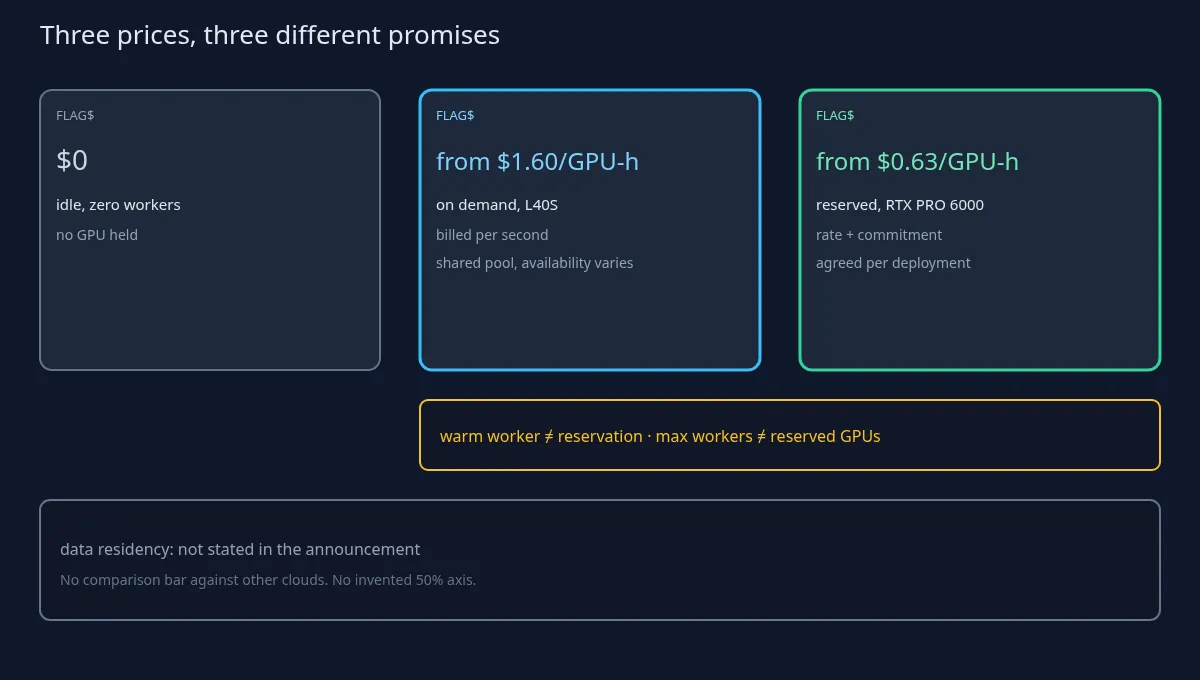
Line up the three numbers and do not blend them. All three are vendor list prices. $0 compute while idle at zero workers. From $1.60/GPU-hour on demand (L40S), per-second billing, no long-term commitment, shared capacity. From $0.63/GPU-hour reserved (RTX PRO 6000), rate and commitment agreed per deployment. “From” means a floor on one GPU type; rates vary by hardware.
The headline problem in one sentence: the page title and first line lead with $0.63, which is the reserved floor. A reader who only sees the title will price an on-demand workload at less than half its actual starting rate.
“Half the cost of a neocloud” is the vendor’s claim. The post gives no basis for the comparison: which neocloud, which GPU, which utilization, which period. We have not verified it, and this article does not compute a percentage of its own.
Billing details worth an MSP’s attention, all from the post: on-demand charges run from the moment a worker holds a GPU until it releases it, including model loading after allocation and warm idle time between jobs. Not billed: waiting for capacity, the image pull before allocation, and Runware-side recovery from a platform failure. Multi-GPU workers are billed for every allocated GPU. On throughput, the post argues that the hourly rate alone does not show what a workload costs, because the work done per GPU-hour varies. That is true in general, and it also means none of these prices can be turned into a per-request cost. The post has no TCO table, no customer savings figure and no comparison with named hyperscalers.
Runware’s own point, paraphrased: keeping a worker warm costs money and does not constitute a capacity reservation. Warm workers help latency; a reservation secures an agreed amount of GPU capacity. Those are different promises, and mixing them up is how an SLA gets written against the wrong control.
The maximum-worker setting, also from the post, caps the worker count and does not reserve those GPUs in the shared pool. On-demand scale-up happens “subject to GPU availability”, and jobs wait in the queue when capacity is not there. Multi-GPU workers need several GPUs free at once and may take longer to place when the pool is busy. The post’s own remedy is to reserve a baseline.
Cold starts: Runware says it has built startup optimizations and persistent volumes for weights and caches, and that start times still vary with model size, runtime, availability and configuration. There are no published cold-start numbers, and this article does not estimate any.
For an MSP, that means: if a customer contract promises a response time, the on-demand pool plus a warm worker is not, by the vendor’s own description, a capacity guarantee. The guarantee is the reserved baseline, priced and committed per deployment. That is a contract question, not a criticism. Questions for the order form: the size and GPU type of the reserved baseline; what happens to queued jobs when demand exceeds the reservation; and whether platform-failure recovery comes with any service credit (the post says recovery is not charged; it does not mention credits or an SLA).
The gap first: the launch post does not name regions, data residency, data-processing terms, subprocessors, or retention for logs and job payloads. We do not fill any of those in, and the Sonic Pod description does not reveal a region either.
Why it matters to an MSP hosting a customer’s fine-tune or private model: the weights, the job inputs, the outputs and the logs shown in the dashboard are all customer data or derived from it. Bringing your own container keeps control of the runtime; it does not by itself say where the GPUs sit or who can see the volumes.
Questions to ask Runware before a customer workload goes on it, as questions and not accusations: where do workers and persistent volumes physically run; can a deployment be pinned to a region; how long are job payloads, results and logs retained; who are the subprocessors; how are secrets passed to containers; what happens to volumes when an app is deleted.
Treat API keys and model-registry credentials for this platform like any other production secret: vault, rotation, least privilege. The page makes no sovereign-cloud, certification or jurisdiction claim, and neither does this article.
This is not Prime Inference, a different inference offering, and there is no comparison table here. It is also not Nebius and Inferize, an acquisition aimed at cold starts inside Nebius Token Factory; that deal is a separate story.
This is not Cloudflare Web Search: that is a search product, not GPU compute. This is not a model launch and not a chip story: Runware Serverless is a compute layer for your own workloads. No model benchmarks, no accelerator roadmaps.
In short, the only prices the page supports, all of them vendor list prices: $0 idle compute at zero workers; on demand from $1.60/GPU-hour on L40S, with per-second billing on shared capacity; reserved from $0.63/GPU-hour on RTX PRO 6000, with commitment terms agreed per deployment. “Half the cost of a neocloud” is an unverified vendor claim. Cold-start and throughput statements have no public benchmarks. The announcement does not state data residency.
Before signing, get the reserved baseline, the queue behaviour above it and the residency answers in writing. Until then, quote the on-demand rate, not the headline.