





















01
Necessary Always on
Required for the site to work (login, preferences, security). Always on.
Ascerta, formerly Pay-i, said on 30 September 2026 that it raised an $18 million Series A led by Dell Technologies Capital, bringing total funding to $22.9 million. Its 47, 24 and 86 percent customer figures are company claims, not an Altovar audit.
This story is company press dated 30 September 2026, datelined Bellevue, Washington, and bylined David Tepper, published on the Ascerta press page. Ascerta, formerly Pay-i, said it raised $18 million in a Series A led by Dell Technologies Capital, and that the round brings total funding to $22.9 million.
The same page names the rest of the participation: Hitachi Ventures, BGV, Wipro Ventures, and earlier investors FUSE, Tola Capital, and Gaia Ventures. That list is who the press page prints. It is not a cap table we reconstructed, and it does not include a share count the page did not print.
The announcement is an enterprise-AI-management story: what AI costs, how people adopt it, and whether an initiative is worth scaling. It is not an audited financial statement and it is not a security certification. The page says that across customers the platform improved ROI on AI initiatives by 47 percent, reduced agent launch times by 24 percent, and cut wasted AI spend by 86 percent. Those three lines are company customer claims. Altovar did not audit them.
The MSP point is which number lands on the order form and which number stays inside the press quote. A round size and a percentage of “waste” can sit in the same paragraph on a vendor site and still be different kinds of sentence. One is the company saying it raised money. The other is the company saying its customers moved a metric. Neither sentence is a worksheet a buyer can book.
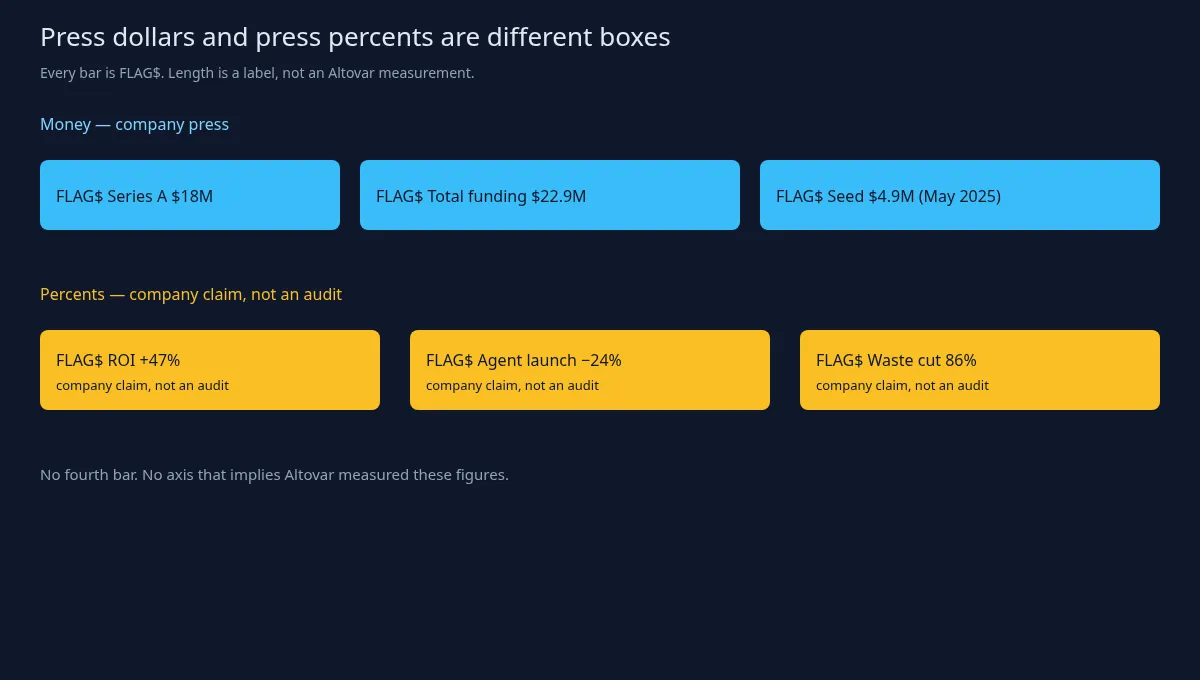
Every sentence in this section rests on the 30 September 2026 press page. The category language on that page moves from AI cost management toward “Enterprise AI Management,” described as one system for what AI costs, how people use it, and which initiatives produce measurable business value. “Measurable” is the company’s adjective. This article does not supply the measurement.
The founding paragraph is a press biography, not an employment verification. The page says Ascerta was founded in 2024 by David Tepper, Doron Holan, and Erik Winters. It says Tepper is chief executive and co-founder, that he spent 19 years at Microsoft, and that he led generative-AI strategy for internal use across Azure. It says Holan spent 27 years at Microsoft and architected hyperscale throttling. Those are the page’s sentences. They are not CVs Altovar checked against a payroll system, and they are not upgraded here into operating history beyond the press bio.
The earlier round is also a company figure. The page says the company emerged from stealth as Pay-i in May 2025 with a $4.9 million seed focused on AI cost management. The Series A is the new name plus a wider claim about the lifecycle of an initiative, not only the cost line the seed was written around. Both dollar figures stay company figures. Adding them on a whiteboard does not make them an Altovar total; the page already states its own total, and that total is the one this article repeats.
Three product names appear, and they are described, not reviewed. Atlas is the page’s name for value, adoption, and ROI from one workflow out to a portfolio. Forge is the page’s name for coding-agent use by engineering teams. Convoy is the page’s name for organizations that provision their own capacity. The page lists three products. It does not print a price, a SKU table, or a deployment mode. This article does not invent those missing fields. A buyer who needs a deployment mode has to find it on an order, not in this paragraph.
The connectors the page names are homegrown applications and what it calls the “most common” enterprise tools, including the Microsoft Copilot suite, Amazon Bedrock AgentCore, Salesforce Agentforce, GitHub Copilot, Claude Code, and Codex. “Nearly all” major tools, and “most granular accuracy on the market,” including sub-token costs, hidden fees, and enterprise discounts, are company superlatives. They are not a benchmark we ran. A connector name on a press page is a name. It is not an exhibit that lists which estates are in a particular customer’s scope.
Customers and partners are only the names the page uses, and only with “including.” Customers including Atos, Wipro, and unnamed “global insurance carriers.” Partners including Microsoft, AWS, IBM, Slalom, and Trace3. “Including” is not a full customer list. This article does not add logos, and it does not turn two named customers into a market share.
Three remarks are allowed as paraphrase, not as operating proof. Tepper, on the page, talks about vanity metrics such as tokens, lines of code, and agent runs. Florin Rotar, identified on the page as Group CTO and Chief AI Officer at Atos, talks about Atos’s own operating model needing measurable value. Raman Khanna, Managing Director at Dell Technologies Capital, calls Ascerta a system of record for AI value creation. Khanna’s category sentence is investor marketing. Rotar’s wording about that operating model is his quote about Atos. It is not an Altovar certification and not an Ascerta certification. This article paraphrases him only as a press quotation. Use of proceeds, only as written: scale the platform and the go-to-market team, extend integrations, and turn research on AI value optimization into new products. That is a plan sentence. It is not a delivery date.
Six figures line up here, and they do not blend. Money, all as stated by the company on this press page: $18 million Series A, $22.9 million total funding, $4.9 million seed. Percentages, all company customer claims on that same page: 47 percent ROI improvement, 24 percent shorter agent launch, 86 percent less wasted AI spend. None of the six is an Altovar measurement, and none is a forecast we are willing to extend. A reader who adds the seed to the Series A and compares the sum with the stated total is checking the press page’s own arithmetic, not auditing a bank. The page’s stated total is the figure this article uses, and it remains a company figure.
A press ROI is not a result a customer can book. The page does not give a baseline. It does not name a cohort. It does not give a time window. It does not define “wasted.” It does not say whether 47, 24, or 86 is a median, a mean, or a single logo. This article will not invent those missing fields to make the percents easier to defend. The accurate sentence is the short one: the page does not say how the percent was computed. Until a worksheet arrives with a definition, the percent stays a sentence in a press page.
The same refusal applies to the fields the page does not give at all. There is no valuation. There is no annual recurring revenue. There is no headcount. There is no customer count beyond the names already quoted with “including.” This article does not fill those fields from other sources or from other companies’ funding announcements; numbers from one announcement do not migrate into another because both companies can be filed under “AI.”
This is not a product review of Ascerta. The questions follow from this page.
Is the purchase Atlas, which the page describes as portfolio value, Forge, which it describes as coding-agent adoption, Convoy, which it describes as the customer’s own capacity, or a bundle of more than one? The contract should name which. The press page lists three products and does not price them. A proposal that says “the Ascerta platform” without a product name has not answered the question the page itself opened.
Which AI estates are in scope: the Copilot suite, Bedrock AgentCore, Agentforce, GitHub Copilot, Claude Code, Codex, homegrown applications, or a list the order form actually attaches? “Most common” is not an exhibit. A connector mentioned in a press paragraph is a candidate. It becomes scope only when the order names it.
Where do prompts, agent traces, and cost records go, for how long, and which subprocessors see them? This article does not invent Ascerta’s processing agreement. The fetched page does not quote one. The ask is the question. If the answer is a trust-center adjective, the next ask is the schedule, not the adjective.
Will the 47, the 24, and the 86 appear in a success criterion? If a seller pastes them into an order, ask for the worksheet that defines baseline, cohort, window, and what “wasted” means. Until that worksheet is attached, the three lines stay press. A company claim does not become a service credit because it was copied into a statement of work.
Coding-agent visibility, Forge as the page describes it, is not customer-code custody. A management view of how engineering teams use agents is a different control from the question of whether a workspace left a laptop. Both can matter to the same MSP. They are not the same ticket.
This raise does not prove where data sits. Rotar’s sentence about Atos is not a residency certificate for Ascerta. A Series A is not evidence of residency, and an investor’s category line is not a control. The buyer’s last question is still the first one: which number is on the order, and which number is still only “the company says.”
The only money the press page supports, each line still a company figure, is an $18 million Series A led by Dell Technologies Capital; participants named as Hitachi Ventures, BGV, Wipro Ventures, FUSE, Tola Capital, and Gaia Ventures; total funding of $22.9 million; and a $4.9 million seed in May 2025 when the company was called Pay-i. The three percentages stay company claims: 47 percent ROI, 24 percent agent launch time, 86 percent wasted spend.
This is not a certification, and it is not an Altovar ROI study. The buyer who needs a number they can defend takes it from an order and a worksheet, not from a press percentage.