





















01
Nécessaires Toujours actif
Indispensables au fonctionnement du site (session, préférences, sécurité). Toujours actifs.
À partir du 5 octobre 2026, OpenAI permet aux clients de l'API du monde entier d'activer volontairement le filigrane textuel sur des modèles sélectionnés (désactivé par défaut), et, dans les semaines à venir, ajoutera un filigrane invisible, textGrain, aux textes ChatGPT et Codex éligibles dans l'UE. Ce que prouve un résultat de détection, et ce qu'il ne prouve pas.
From 5 October 2026, OpenAI says API customers worldwide can opt in to text watermarking on select models (off by default), and over the coming weeks it will add an invisible watermark, textGrain, to eligible ChatGPT and Codex text for users in the European Union. It is not a global ChatGPT default at launch. The primary source is OpenAI's post Our approach to EU text provenance rules; the Help Center article on provenance signals lists the text row as "textGrain watermarks (EU only)."
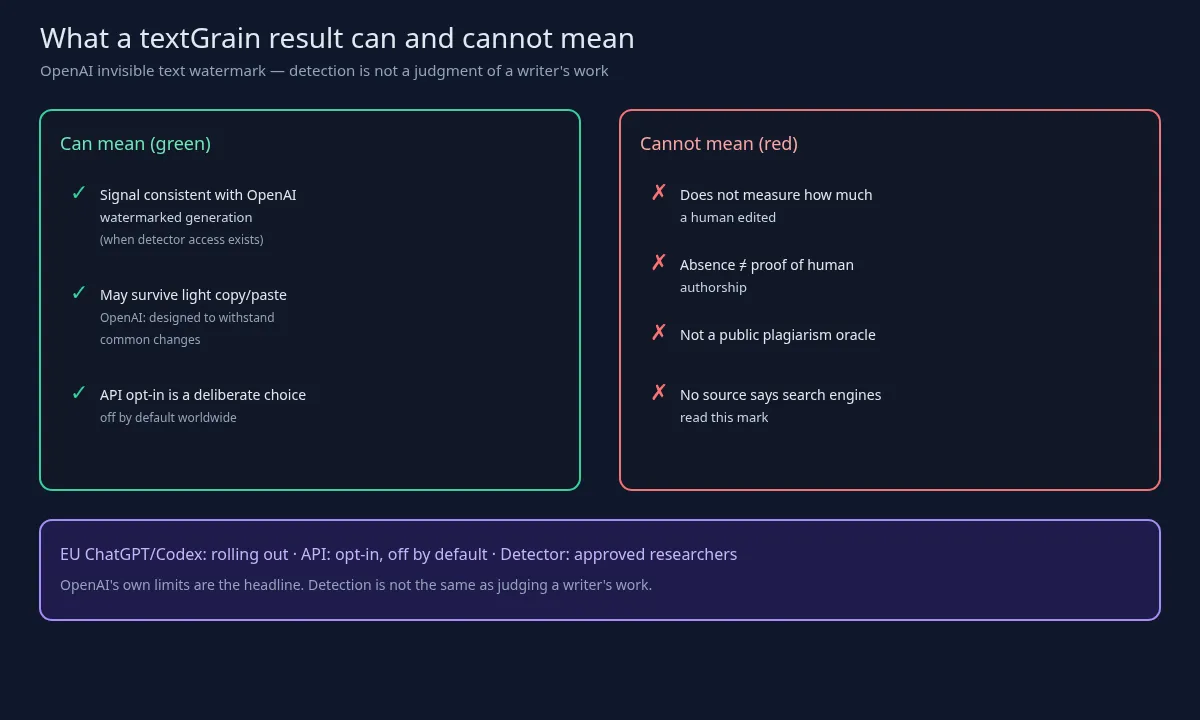
In short: a detection result can suggest that an OpenAI system generated or processed part of a passage. OpenAI itself says a watermark does not measure human contribution, and a missing mark does not prove a person wrote the text.
This article covers how textGrain works in broad terms, the published detection rates and editing limits, who can run the detector, one factual line on Article 50 of the EU AI Act, and what all of this means for SEO and GEO at agencies with writers in more than one country. It is not a guide to removing or evading a watermark.
EU apps. Over the coming weeks, OpenAI says it will introduce text watermarking for eligible ChatGPT and Codex users across all plans, in the EU only. OpenAI says the regional approach gives it room to learn from real-world use and feedback. The Help Center lists text watermarks as EU-only for ChatGPT-generated text.
API. Starting 5 October 2026, API customers globally can opt in to text watermarking for select models; it stays off by default. According to the Help Center, the switch sits in Organization settings (Data controls, then Text provenance) with a per-project override, and customers choose which models receive the watermark. OpenAI's post does not name the models; the Help Center says the eligible list is shown in settings and that coverage will extend to legacy models over the coming weeks. Name an owner for the organisation setting before anyone turns it on.
Cloud partners. OpenAI says it is working with cloud partners to make watermarking available for OpenAI model outputs accessed through their services in the coming weeks. It has not named the partners.
How Anthropic differs. Anthropic marks text from supported Claude models worldwide with a version of Google DeepMind's SynthID-Text, according to Search Engine Journal's summary of Anthropic's support material. OpenAI chose a regional rollout for its apps. That is a difference in product strategy, not a ranking of which mark is "better."
Why the EU now. OpenAI frames the work as a response to the EU AI Act, which requires generative AI providers to make generated text identifiable in a machine-readable way. Article 50 transparency rules have applied since 2 August 2026; according to European Commission guidance reported by Search Engine Journal, systems placed on the market before that date have until 2 December to meet the marking and detection obligation. This article is not a compliance checklist and offers no legal interpretation.
In OpenAI's description, textGrain subtly adjusts how the model randomly chooses between possible next words or word pieces, so that a detector holding the secret key can look for a statistical pattern. It does not insert hidden characters, invisible spaces or unusual punctuation. The technical report dated 5 October 2026 describes entropy-calibrated watermarking that couples token choice to keyed randomness through optimal transport over vocabulary blocks; the detector needs only the generated text and the secret key, not the entropy budget used during generation. OpenAI says it plans to release textGrain as open source.
Detection numbers, all from OpenAI's published evaluations. At a 1 percent false-positive target, the company reports about 80 percent detection on 200-token passages and about 95 percent on 400-token passages for content such as psychology, with substantially lower performance on mathematics. On editing, OpenAI reports that on 400-token passages, replacing 10 percent of words with synonyms reduced detection from about 92 percent to 66 percent, and replacing 25 percent of words reduced it to 17 percent.
These synonym figures are reliability limits. They describe how detection behaves after common edits. This article does not explain how to weaken or remove a watermark.
Detector access is gated. OpenAI is taking applications, and access is initially limited to approved researchers and expert organisations. The tool reports whether it detects an OpenAI watermark; it does not identify the user or reveal prompts or conversations. OpenAI cites the risk of missed watermarks and false positives as the reason it is not making the detector public at launch.
Will a watermark hurt our SEO, or will Google penalise marked copy?
OpenAI says a watermark does not measure human contribution and its absence does not prove human authorship. None of OpenAI's EU post, the Help Center article, the technical report or Search Engine Journal's coverage claims that search engines read or score textGrain. This article therefore claims no ranking effect, penalty or boost.
The practical issue for agencies: as Search Engine Journal points out, a team with writers in Berlin and Toronto on one ChatGPT plan may soon produce marked and unmarked copy from the same workflow, depending on which region applies during the rollout. Detection also varies by language. In an OpenAI test across the 24 official EU languages at a 1 percent false-positive rate, Spanish had the highest detection rate (69.0 percent) and Romanian the lowest (42.2 percent), before OpenAI strengthened the signal for weaker languages. OpenAI also says substantial paraphrasing or translation can make a watermark undetectable. Policies and contracts should not treat a private detector result as proof of who wrote a page. A watermark is a provenance signal for parties with detector access. It is not a byline.
What to put in an AI-use policy instead: disclose the process, keep human review where the client requires it, and log which tools touched a draft. None of that requires a watermark score. The Help Center page also covers image, audio and video provenance; this article stays with text.
Six practical habits for buyers and MSPs that support writing teams across borders.
1. Map regions. Map which staff use ChatGPT or Codex from EU accounts versus non-EU accounts. Watermark presence may differ by region during the rollout, even inside one company.
2. Decide on API opt-in deliberately. The default is off. Name an owner for the organisation or project setting, and record the decision in the change log.
3. Do not build customer acceptance tests on detector access you do not have. Access for approved researchers is not a helpdesk tool.
4. Treat third-party "AI detectors" as unrelated products unless they prove they use OpenAI's key. OpenAI's Help Center notes that third-party tools typically use classifiers that analyse text after it is written, rather than detecting an embedded signal. A confidence dial on a marketing page is not textGrain.
5. For regulated buyers, point to OpenAI's published limits rather than overselling certainty. The synonym-edit figures and the lower detection on mathematics belong in an honest answer.
6. Keep Article 50 references factual and short. Legal interpretation belongs with counsel.
One more note for teams that work across countries. During the EU rollout, the same prompt typed by two colleagues can produce text that does and does not carry a watermark, depending on where their ChatGPT or Codex session is considered to sit. Do not turn that difference into a blame game about who "used AI." Turn it into a documented process: which tools are approved, who reviews, and what gets logged before a page goes live.
Key facts. textGrain rolls out on eligible EU ChatGPT and Codex text over the coming weeks. API opt-in has been available worldwide since 5 October 2026 and is off by default. The detector is for approved researchers and expert organisations. OpenAI's detection rates and synonym-edit figures are reliability data. A watermark does not measure human contribution. None of the sources cited here says search engines read the mark. Article 50 appears here as one factual line.
Sources: OpenAI, Our approach to EU text provenance rules (5 October 2026); OpenAI Help Center, Provenance signals in OpenAI-generated content; OpenAI, textGrain technical report (5 October 2026); Matt G. Southern, OpenAI To Watermark ChatGPT Text In The EU, Opens API Opt-In, Search Engine Journal (5 October 2026).