





















01
Nécessaires Toujours actif
Indispensables au fonctionnement du site (session, préférences, sécurité). Toujours actifs.
Le 7 octobre 2026, OpenAI a annoncé GPT-6 et Intelligent UI pour tous. « GPT-6 commence à être déployé dans le monde entier dès aujourd'hui sur les formules ChatGPT Plus, Pro, Business et Enterprise dans l'onglet Chat », a écrit la société, et « à partir de demain, le déploiement s'étend aux formules Free et Go » — c'est-à-dire à partir du 8 octobre. Les formules payantes bénéficient de GPT-6.
On 7 October 2026 OpenAI announced GPT-6 and Intelligent UI for everyone. GPT-6 "starts rolling out globally to ChatGPT Plus, Pro, Business and Enterprise tiers today in the Chat tab," the company wrote, and "starting tomorrow, the rollout expands to Free and Go tiers" — that is, from 8 October. Paid tiers get GPT-6 Sol; Free and Go get GPT-6 Luna. "Enterprise availability depends on workplace admin settings," and the models powering Work and Codex "are not changing as part of this release."
The part that matters to anyone who publishes on the web is the new capability. OpenAI calls it Intelligent UI: "a new capability that allows ChatGPT to answer quickly with fully interactive user interfaces," and "a step toward a ChatGPT that can shape an interface around what you're trying to do." When an answer can be an interface instead of a paragraph, the content most likely to survive the trip is content that is already structured, dated and unambiguous. OpenAI has not said how Intelligent UI picks or credits sources, so this article does not guess at ranking or traffic effects.
Below: the rollout facts, OpenAI's own safety rating in one paragraph, what answers-as-interfaces change for SEO and GEO, and a short checklist for site owners and MSP admins. We read OpenAI's announcement and its Deployment Safety Hub page on 8 October 2026.
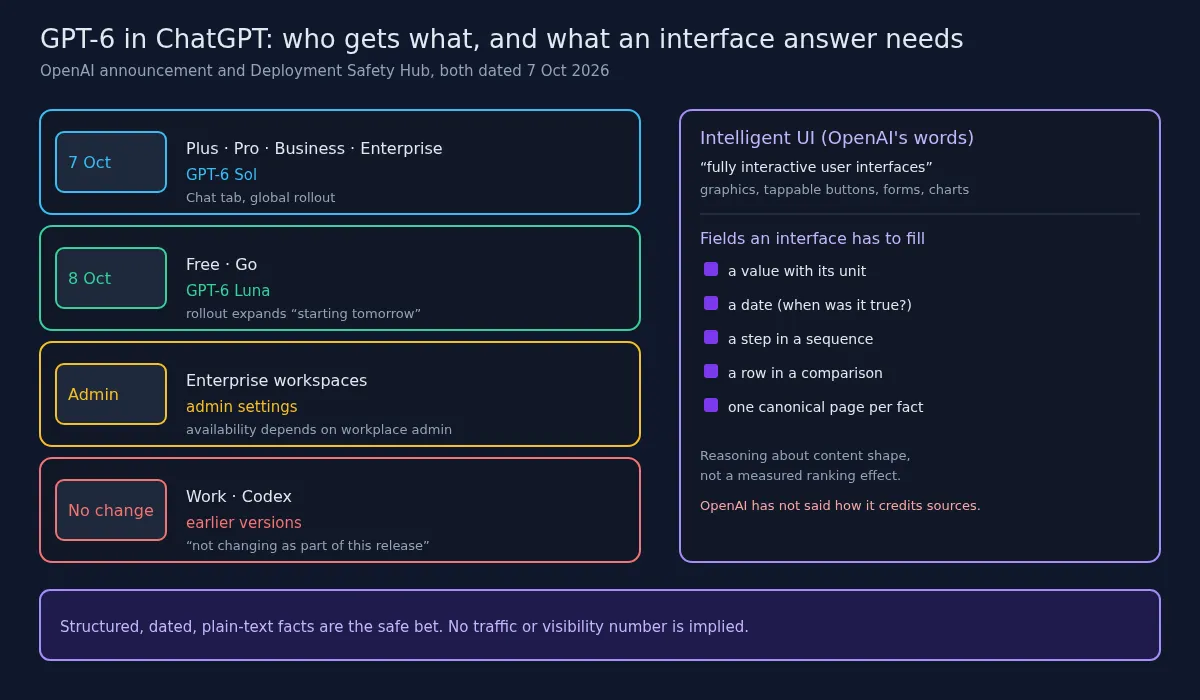
Paid tiers, 7 October. Plus, Pro, Business and Enterprise, globally, in the Chat tab, on GPT-6 Sol. OpenAI says both GPT-6 Sol and GPT-6 Luna are "tuned for everyday conversation."
Free and Go, 8 October. The rollout expands to Free and Go on GPT-6 Luna. A staged rollout means not every account sees the change at the same minute, and OpenAI has not published an account-by-account timetable.
Enterprise is an admin decision. "Enterprise availability depends on workplace admin settings." For MSPs and IT teams this is a workspace-settings question before it is anything else.
Scope. Chat only: "This update applies to the Chat experience in ChatGPT." The Deployment Safety Hub page, published the same day, adds that the new models "will replace GPT-5.6 Sol and GPT-5.6 Luna in ChatGPT," while people using GPT-6 Sol and Luna in Codex and via ChatGPT Work "are still using previously released versions."
What Intelligent UI is, in OpenAI's words. The company says it trained GPT-6 "to compose responses using text, visuals and interactive elements," and that responses "can include graphics, tappable buttons, forms, charts, and interactive experiences." It describes a library of native, streamable components and a compiler that lets the interface appear while the model is still generating. It also says that "when a simple text answer is the most useful response, ChatGPT can give you that." OpenAI frames the release as reaching "more than 1.2 billion people who use ChatGPT each week"; that is the company's figure.
What OpenAI did not say. Neither the announcement nor the safety page explains how Intelligent UI chooses sources, whether citations appear inside generated interfaces, or how outbound links are shown. Anyone who tells you otherwise today is guessing.
OpenAI's own rating. The Deployment Safety Hub page, "Published October 7, 2026," says that under its Preparedness Framework OpenAI is "treating this October release of GPT-6 Sol and GPT-6 Luna as High capability in both Cybersecurity and Biological and Chemical domains," and that "neither one reaches our High threshold in AI Self-Improvement." OpenAI says it implemented the same set of safeguards for both models. It also reports stronger resistance to jailbreaks than GPT-5.6 Sol and GPT-5.6 Luna in ChatGPT, including attacks that adapt across multiple turns, in its own evaluations.
How to read it. This is the vendor's self-assessment, published on a vendor site. It tells buyers which safeguard tier OpenAI says applies to the models. It does not tell a particular company how to configure access for its own staff. For regulated customers the useful step is to read the hub page next to your own acceptable-use policy and decide what changes, if anything, now that the default Chat model is new. This article does not reprint OpenAI's evaluation figures; they are on the hub page for anyone who needs them.
Everything in this section is our reasoning about content shape. It is not an OpenAI statement and not a measured outcome.
The shift. A text answer quotes or paraphrases. An interface answer has to fill fields: a value, a unit, a date, a step, a row in a comparison. Content that already states those things cleanly is easier for any answer engine to reuse correctly, whether it renders a paragraph, a chart or a form.
Your layout is not what travels. OpenAI says the interface is composed from its own library of components. Whatever a user sees inside ChatGPT is OpenAI's design, filled with information. On that reading, what can travel from your page is the facts and their context, not your layout, so the work is in making those facts easy to extract and hard to misread.
What to publish. Explicit numbers with units and dates. Tables with clear headers. Short FAQ blocks in which the question is the heading and the first sentence answers it. One canonical page per fact, rather than the same figure stated three slightly different ways on three pages.
What tends to get lost. Claims buried in long introductions, prices or specs that exist only inside images, "contact us for details" pages, and statistics with no date. If an interface needs a number and your page hides it, the interface will take it from someone else or leave it out.
Attribution, honestly. OpenAI has not said how Intelligent UI credits sources. Do not promise clients "visibility in GPT-6"; from the announcement alone, nobody outside OpenAI can measure it. Watch your own referral data instead of borrowing a vendor's user numbers.
Freshness. Dated facts let any answer engine prefer the current value over a stale one. Put a visible "last updated" date on pages that carry prices, versions or limits, and change it only when the content changes.
A checklist for site owners and MSP admins.
Where it stands on 8 October 2026. OpenAI announced GPT-6 in ChatGPT on 7 October: GPT-6 Sol for Plus, Pro, Business and Enterprise from that day, GPT-6 Luna for Free and Go from 8 October, Enterprise subject to admin settings, Chat only, with Work and Codex models unchanged. According to the Deployment Safety Hub, the new models replace GPT-5.6 Sol and Luna in ChatGPT, and OpenAI rates both as High capability in cybersecurity and in biological and chemical domains under its own framework. Intelligent UI means answers that can arrive as interactive interfaces, in OpenAI's words. No source explains how those interfaces credit sources, so this article makes no ranking or traffic claim. Structured, dated, canonical facts remain the safe bet.