





















01
Necesare Mereu activ
Indispensabile pentru funcționarea site-ului (autentificare, preferințe, securitate). Mereu active.
Dacă scanerul tău de dependențe a declanșat alerte legate de Payload săptămâna aceasta, remedierea nu este nouă. Payload, CMS-ul headless open-source pe care multe agenții și MSP-uri îl implementează pentru site-urile clienților, a publicat un set de avisuri de securitate pe 18 septembrie 2026 împreună cu versiunea 3.90.0, care le corectează. Înregistrările CVE și cele de la GitHub au fost analizate.
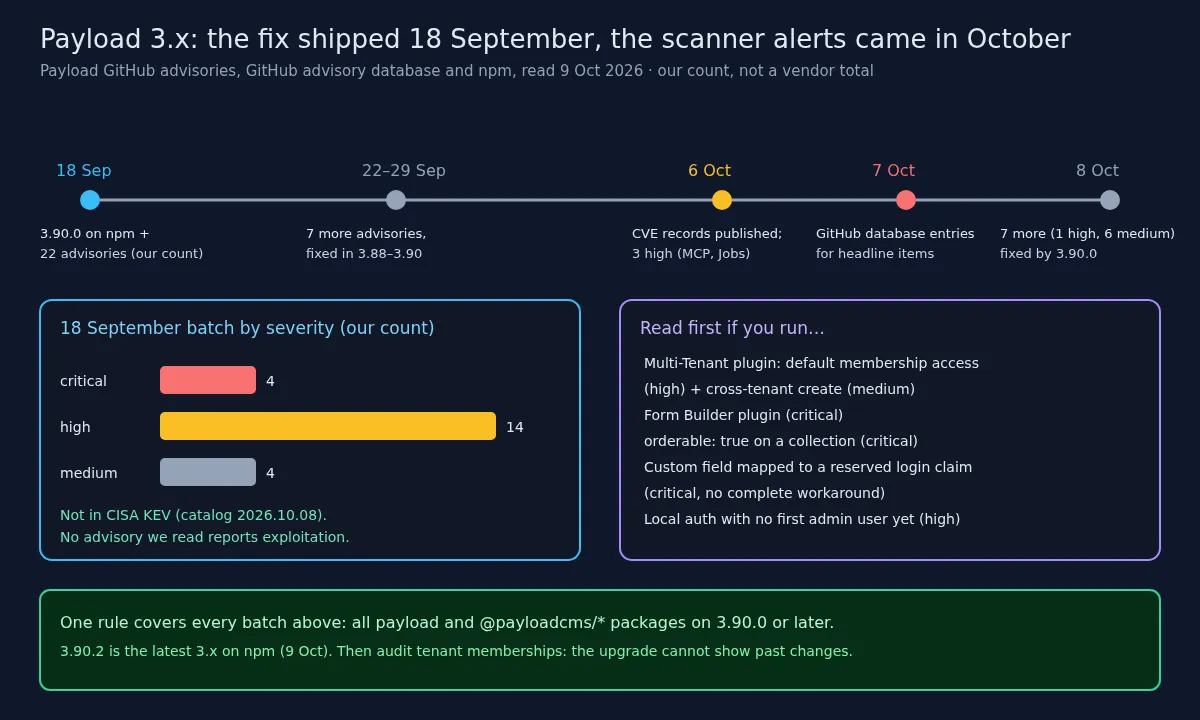
If your dependency scanner lit up about Payload this week, the fix is not new. Payload, the open-source headless CMS that many agencies and MSPs deploy for client websites, published a batch of security advisories on 18 September 2026 together with version 3.90.0, which fixes them. CVE records and GitHub's reviewed advisory database entries followed on 6–7 October, and that is what Dependabot and similar tools read, so the alerts are landing about three weeks after the patch. The batch is large: by our count from GitHub's API, 22 advisories dated 18 September in Payload's repository, four rated critical, fourteen high and four medium.
For MSPs, the one to read first is in the Multi-Tenant plugin, the add-on that lets one Payload install serve several clients: with the plugin's default settings, an authenticated user could assign themselves to other tenants. Others cover the Form Builder plugin, collections that use the orderable option, login token handling and fresh installs that never got a first admin user. None of these appears in CISA's Known Exploited Vulnerabilities catalog, and none of the advisories we read reports exploitation. Our thesis: patching is the easy half. If you ran an affected version with these features for months, you also need to check who belongs to which tenant today. Below: what changed, what applies to you, how to confirm your version, and a post-upgrade review. Sources: Payload's advisories and npm data via GitHub's and npm's APIs, and the CISA catalog, all read on 9 October 2026.
Read these as "affected if" statements; each depends on a feature you may or may not use. Multi-Tenant plugin, tenant membership (GHSA-p96c-xwx8-3cqj, CVE-2026-105860, high, CVSS 4 score 7.1). Payload's advisory says that with the plugin's default tenant array field access, "an authenticated user could assign themselves to other tenants". You are not affected by this default behaviour if you had already configured the membership field's create and update access yourself. A companion advisory (GHSA-xhm9-gwgw-3q2q, CVE-2026-105864, medium) says a user limited to one tenant could create a record in another tenant, though reads and direct edits of existing documents there were not bypassed.
Orderable collections (GHSA-f7hx-52q9-hcrf, CVE-2026-105859, critical, CVSS 3 score 9.8). If any collection or join field uses orderable: true, documents could be updated regardless of access control. Form Builder plugin (GHSA-r488-j9vj-wx3q, CVE-2026-105857, critical, CVSS 3 score 10.0). If you use the plugin, crafted submissions could run code on the server. Login token (GHSA-66wr-7vmr-p5jq, CVE-2026-105863, critical, CVSS 4 score 9.2). Affects setups where a custom field option maps a field to a reserved authentication claim name; Payload says there is no complete workaround. First admin user (GHSA-97rh-rhh2-7vjv, CVE-2026-105858, high, CVSS 3 score 8.1). Affects apps using local authentication that still have no initial user, a state that new or forgotten staging installs can sit in for weeks.
All of the above is fixed in 3.90.0 and, on the 4.0 canary line, from 4.0.0-canary.34. The rest of the 18 September batch covers, among other things, field-access checks on auth collections, API key exposure through ordinary document reads, upload handling, SVG sanitisation, SQL injection in the SQLite and Postgres adapters, and the Stripe and Ecommerce plugins, all fixed in 3.90.0 or, for some adapters, earlier releases. We are not reproducing any technical detail beyond what you need to decide whether you are affected.
The timing explains the noise. Payload published its advisories in its own GitHub repository on 18 September, the same afternoon 3.90.0 reached npm. Scanners such as Dependabot mostly work from GitHub's reviewed advisory database and from CVE records, and for these items those appeared on 6 and 7 October. If your team patched in September, the alert is a confirmation; if not, it is a three-week-old gap.
More advisories followed the fix. Between 22 and 29 September Payload published seven more, fixed in 3.88.0 to 3.90.0. On 6 October it published three high-severity ones: two in the MCP plugin (one about login responses including fields that are normally hidden, one about password recovery giving an authenticated MCP user access to another account), both relevant only if those MCP tools are switched on, and one about Payload Jobs, relevant if Jobs are enabled and untrusted users can reach the Jobs collection. Their fixes are in 3.88.0, 3.90.0 and 3.89.0 respectively. On 8 October a further seven followed, one high and six medium, also fixed at or below 3.90.0. So one rule covers every batch: be on 3.90.0 or later. As of 9 October the latest 3.x release on npm is 3.90.2. None of these appears in CISA's catalog as of its 8 October update.
Why the multi-tenant item deserves the first look, even though it is rated high rather than critical: in a shared install, the tenant list on a user record is the boundary between clients. Payload's advisory describes a default under which that list could be changed by the user it belongs to. For an agency hosting several customers on one Payload app, that turns a routine editor account at one client into a possible way into another client's content, without any server compromise, just a membership change that looks like ordinary data. That is also why upgrading alone does not close the question. The new version stops the change from happening again; it cannot tell you whether it already happened. Only your own data and logs can. Run this in each project to see what is installed, then upgrade every payload and @payloadcms/* package together.
# Which Payload packages and versions are actually installed? (read-only)
npm ls payload @payloadcms/plugin-multi-tenant @payloadcms/plugin-form-builder @payloadcms/plugin-mcp
# pnpm:  pnpm why payload
# yarn:  yarn why payload

# Upgrade all Payload packages together (same version across @payloadcms/*)
npm install payload@^3.90.0 @payloadcms/next@^3.90.0
# ...repeat for every @payloadcms/* package in package.json, then commit the lockfile
Our defender checklist; vendor workarounds are marked as such.
package.json looks right.orderable: true, then review recent edits there for changes by users who should not have write access.To sum up: Payload published a batch of advisories and 3.90.0 on 18 September 2026; CVE records and GitHub-reviewed database entries for the headline items followed on 6–7 October, which is why scanners are flagging them now. By our count, the 18 September batch holds 22 advisories in Payload's repository (four critical, fourteen high, four medium). The MSP headline is the Multi-Tenant plugin: with default membership-field access, an authenticated user could assign themselves to other tenants (high), and a related issue allowed creating records in another tenant (medium). Critical items cover the Form Builder plugin, collections using orderable: true and login token handling; a high-severity item affects installs with no first admin user. Later advisories, including the batches of 6 and 8 October, are fixed at or below 3.90.0. Not in the CISA KEV catalog; no advisory we read reports exploitation. Action: upgrade all Payload packages to 3.90.0 or later (3.90.2 is current), then audit tenant memberships and review Form Builder and orderable-collection access.