





















01
Nödvändiga Alltid på
Krävs för att webbplatsen ska fungera (inloggning, inställningar, säkerhet). Alltid på.
Mistral öppnade en publik förhandsversion av Mistral Large 4, med smeknamnet le Chonk, den 6 oktober 2026: cirka en biljon parametrar, varav 52 miljarder aktiva, tränad i Mistrals egna europeiska datacenter. Vikterna har utlovats till slutet av oktober; licensen har ännu inte offentliggjorts.
On 6 October 2026 Mistral published Introducing Mistral Large 4 and named the model in its own words: "Unofficially ML4, very officially: le Chonk." The public preview API is available on Mistral Studio. Mistral says it will release the weights "by the end of the month"; The Next Web reported 27 October as the date.
Three separate promises sit in that launch. First, a hosted preview you can call now. Second, open weights later, with the licence not yet announced. Third, a European deployment that Mistral says it operates end-to-end under European law. On size, the news post describes a 1 trillion-parameter natively multimodal model with 52 billion active parameters. The model card, labelled Public Preview, Open, v26.10, gives 52B active and 1.05T total parameters, a 1.6B vision encoder and a 1M-token context.
Training, in Mistral's words: the model was trained from scratch on 3,800 NVIDIA Grace Blackwell GPUs in Mistral's own datacenters in Europe, and the public preview is served on that same infrastructure. Below, Mistral's benchmark claims are kept apart from a buyer checklist that treats downloadable weights and the endpoint you actually call as different things.
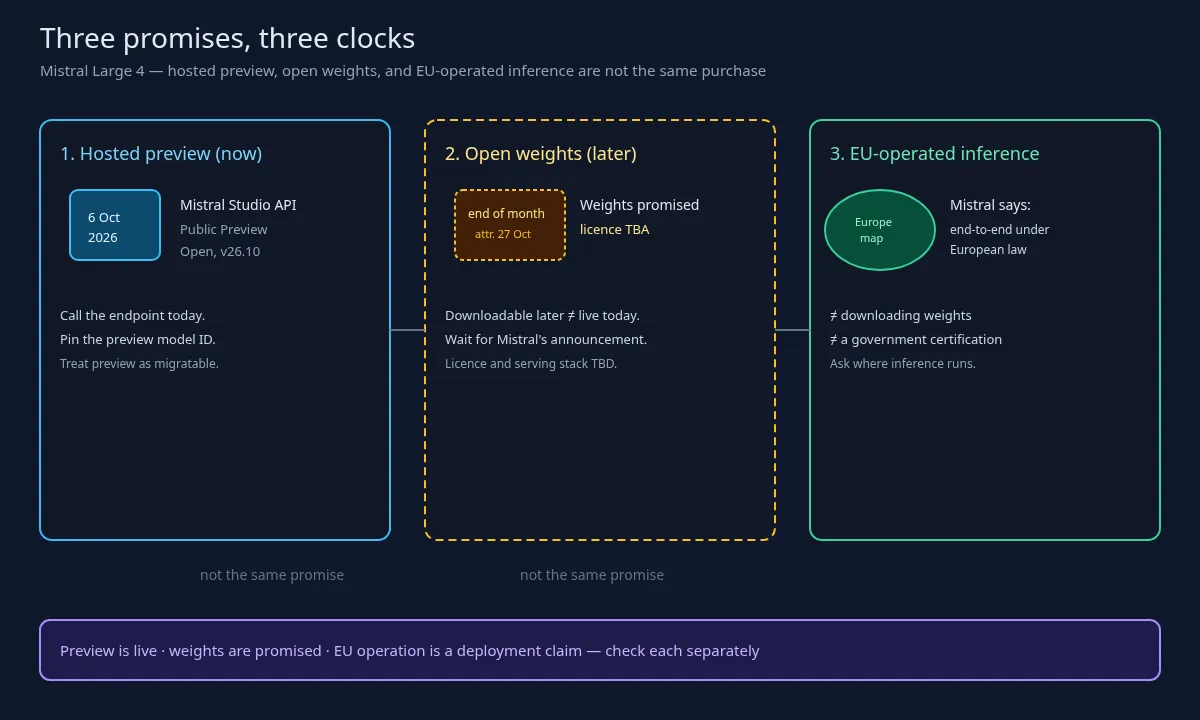
Name and status. The product is Mistral Large 4, nicknamed le Chonk. On 6 October it launched as a Public Preview on Mistral Studio, and the model card labels it Open, v26.10. The weights are not out yet. Until they are, every production decision is a decision about a hosted preview model, not about a file on disk.
Size. Mistral's news post describes "a 1 trillion-parameter natively multimodal model with 52 billion active parameters." The model card gives "52B active parameters and 1.05T total parameters, and a 1.6B vision encoder," with a 1M-token context. Some launch-day coverage reported 49 billion active parameters; Mistral's two pages now agree on 52 billion. Use 52 billion active and about one trillion total (1.05T on the model card).
Training and serving. Mistral says the model was trained from scratch on 3,800 NVIDIA Grace Blackwell GPUs in Mistral's own datacenters in Europe, and that the public preview is served on that same infrastructure. Some secondary coverage rounded the figure to about 4,000; Mistral's number is 3,800. Mistral also says a significant share of the training data was multilingual, spanning more than 160 languages, including every official language of the European Union.
How Mistral frames sovereignty. Mistral says open weights and self-deployment are meant to give customers control over their AI, and that the model will be available in several regions worldwide, including a European deployment that Mistral operates end-to-end, independently of other digital service providers and under European law. That is Mistral's product language about control and deployment, not a government certification.
Funding context. Mistral presents Large 4 as the first milestone on the roadmap funded by its €3 billion Series D, which it calls the largest equity round ever raised by a European technology company, and says it is scaling up compute in its own European datacenters.
What is still coming. Mistral says it will share further details on the architecture, additional benchmarks and its post-training methodology "as we work toward releasing the weights." It also presents ML4 as the foundation for a new generation of specialised Mistral models. Until the weights and the licence are published, treat these as announced plans, not as assets you can deploy.
Every figure in this section is reported by Mistral on its launch page. None has been independently reproduced; read them as Mistral's own results, not as a procurement comparison.
Coding and agentic work. Mistral reports 61.7 percent on DeepSWE v1.1, 59.4 percent on SWE-Atlas-QnA and 28.3 percent on Terminal-Bench 4, with a combined Coding Agent Index score of 49.8 percent. In a blind human evaluation of coding quality that Mistral ran with Surge AI, ML4 Preview scored 3.74 out of 5, second of five models, behind Claude Opus 5 at 4.22.
Cybersecurity. Mistral says ML4 ranks among the top five models globally on the Artificial Analysis Cyber Index and leads open-weight models developed outside China. It reports 82 percent on one of the index's tests, which asks a model to reproduce a real vulnerability in open-source software and then patch it, and says several closed models score near zero there because they refuse the task. Mistral also reports that ML4 solves 93 percent of the 40 Cybench challenges.
Knowledge work and multimodal. Mistral reports 59.9 percent on AutomationBench and 1,393 Elo on AA-Briefcase, and says the third-party evaluator vals.ai found ML4 ahead of GPT-6-Astra on legal and finance tasks. On visual grounding, Mistral reports 42 percent on Dense 200 against 41 percent for GPT-6-Astra. On safety, it reports that ML4 resists 93.3 percent of attacks on Lakera's B3 AI Security Benchmark and scores 1.691 out of 2 on the KORA Benchmark.
For buyers: build your own evaluation set before you replace a production model. Mistral's figures are useful context, not your acceptance test.
Until the weights are released, Mistral says it is red-teaming the model in real-world settings with cybersecurity leaders, vetted partners and state authorities, "who will access the same model with reduced moderation and expanded cyber capabilities." That is a product posture Mistral announced; this article does not describe how such a build would be used.
Mistral's argument is that provider-level refusals can block legitimate vulnerability research and incident response, and that open weights plus self-deployment let organisations run security work under their own policies. That is Mistral's case for the red-team build. The only cyber figures in this article are the vendor-reported scores above.
What that means for an MSP: if a customer asks for "sovereign cyber AI," the verifiable questions are who operates the endpoint, where inference runs, whether the weights can be self-hosted under a published licence, and who owns the refusal policy. Those are contract and inventory questions.
Six habits, each with something that counts as evidence.
1. Separate the three promises. Preview API availability is not weights on disk, and neither is an EU-operated endpoint written into a contract. Evidence: you can name which of the three you are buying today. Not evidence: a slide that says "sovereign" without saying which.
2. Pin the preview model ID and treat the preview as something you will migrate from. When the weights land, the licence and the serving stack are new decisions. Evidence: the deployed configuration shows the exact preview ID, with an owner and a cutover ticket.
3. Wait for the licence. Do not write a licence name into a customer proposal before Mistral publishes the licence for the weights. Evidence: the proposal says "licence to be confirmed on weights release."
4. Ask where inference actually runs for the endpoint you call (region, operator, subprocessors), not only where the marketing page was written. Evidence: a written answer from the vendor or the contract schedule, attached to the inventory row.
5. Run your own evals on your own traffic (format, refusals, latency, tool use) before replacing a pinned production model. Mistral's figures are not your evaluation set. Evidence: a scored eval on your own prompts, with a named reviewer.
6. Confirm commercial terms in your own console before you quote anything to a customer.
Two extra habits for teams that already run open weights elsewhere. Keep the preview endpoint and any future self-hosted checkpoint in separate inventory rows, even if they share a marketing name. And when secondary coverage gives a weights date such as 27 October, watch Mistral's own channels; treat it as a delivery date only once Mistral confirms it.
Key facts. Mistral Large 4 (le Chonk) was announced on 6 October 2026. The public preview is on Mistral Studio. Weights are promised by the end of the month; The Next Web reported 27 October. The model is a multimodal mixture-of-experts with about one trillion total parameters (1.05T on the model card), 52 billion active, a 1.6B vision encoder and a 1M-token context. Mistral says it was trained on 3,800 Grace Blackwell GPUs in its own European datacenters. Open weights are promised; the licence has not been announced. Every benchmark here is reported by Mistral.
Sources: Mistral, Introducing Mistral Large 4 (6 October 2026); Mistral Docs, Mistral Large 4 model card; The Next Web (6 October 2026).